–– Responsible Irresponsibility –– Paul A. Levine (1956–2019)
Paul A. Levine, who left this world on October 28, 2019, would probably have smiled — wryly, perhaps — at the irony of his own afterlife. A committed Hegelian, he loved to observe how contradictions define existence, and he even coined his own dialectical epitaph: “responsible irresponsibility.” Those who knew him recall that he wanted these words engraved on his tombstone — his final intellectual wink at the world.
And yet, in a twist worthy of his own lectures on history’s paradoxes, Paul was buried not under a stone bearing his words, but in a collective grave marked only by a small metal plate listing sixteen names, including “Paul Levine,” a spelling that erases both his middle name and part of his identity. No stone to touch. Just an anonymous patch of ground — restlessly reshaped, as cemeteries now do, six times in as many years.
But perhaps, as Paul might have said, history itself has a dark sense of humor. What could be more fitting for a Historian of the Holocaust — a Man who spent his life exposing the mechanics of forgetting — than to become, in death, a casualty of bureaucratic oblivion?
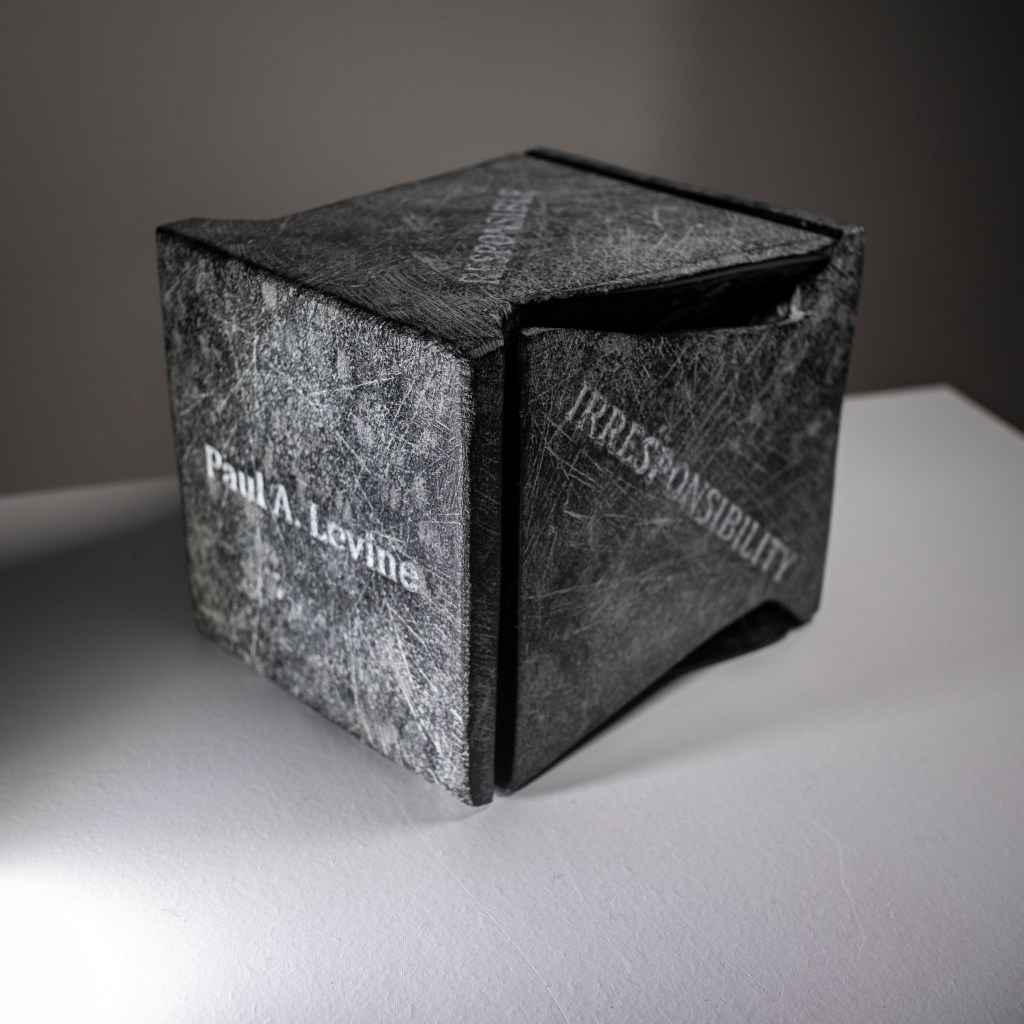
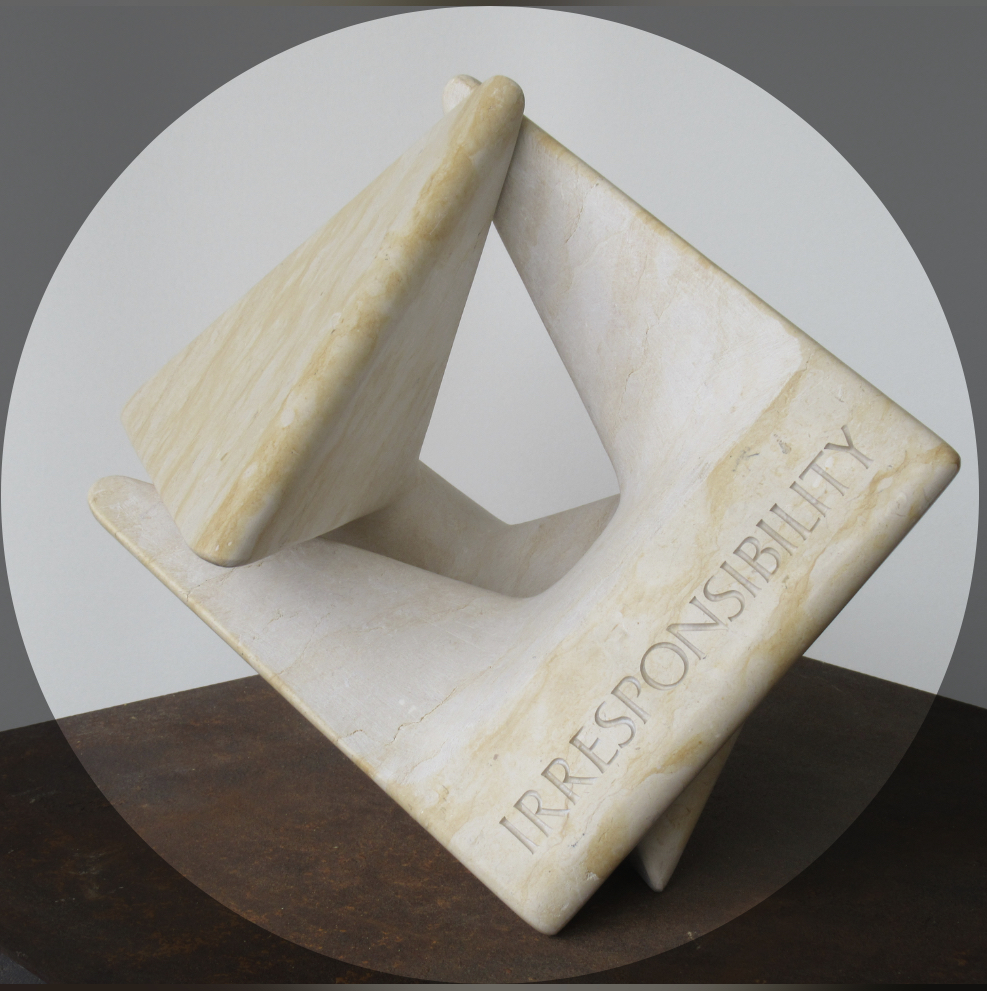
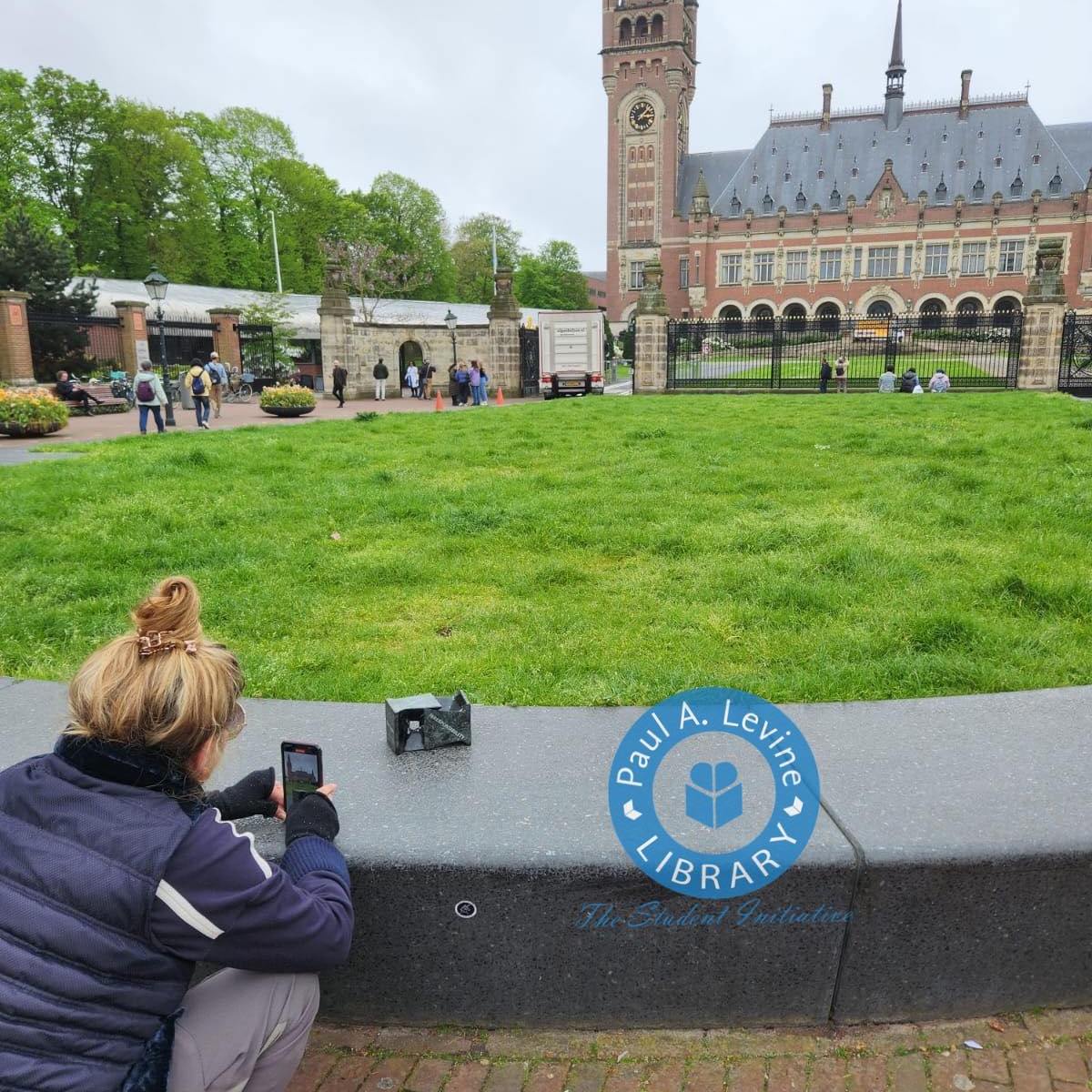
From this contradiction, however, emerged an act of creative defiance: “A Traveling Tombstone”. Together with sculptor Robert Schmidt-Matt, three natural stone sculptures were created to carry Paul’s oxymoronic legacy across lands and cities — from Berlin to New York, from Toronto to The Hague.
PILPAUL
TEVAT PAUL
BEYAHAD LO NI-PAUL
In the end, Paul’s memory travels, debates, provokes — as he always did. His absence, too, teaches. Responsible? Irresponsible? – Both, of course.
The Israeli newspaper Haaretz published an article on April 6th titled “Jews Should Not Have to Take a Detour”, spotlighting the case of Paul A. Levine. (1)
In it, they make one thing painfully clear: Levine is being systematically erased from institutional memory — and that silence speaks louder than any statement.
You can read our latest appeal (2) to the university, but here’s the heart of it:
By refusing to even mention Levine by name, the university sends a clear message: Erasure is easier than accountability. Silence is safer than truth. This isn’t just about ignoring a scholar. It’s about erasing the very questions he dared to ask — and that’s a dangerous precedent.
When an internationally respected Holocaust scholar like Paul A. Levine can simply be removed from memory, we have to ask: Whose memory is protected, and whose gets deleted next? And if this is happening at Sweden’s oldest university — a supposed hub of critical thought — what does that say about the future of Holocaust Studies there?
How stable is the memory we rely on, and how easily can it collapse?
We’ll have to wait and see. But one thing’s for sure: this community is watching.
On behalf of the initiative, I want to thank all of you — some of you have been with us for six years now! Your continued support is what makes this possible.
A special thanks to journalist David Stavrou and Haaretz for shining a light where others prefer shadows.
“Dear Elena and the Paul A. Levine Library, In regards to your questions about the conference you refer to, it was not arranged by Uppsala University and thus, I cannot answer any questions on how it was organized. In regards to your questions concerning the renaming of the Hugo Valentin Centre, I refer to my previous answer.”
In fact, this reply is yet another disheartening attempt by the university to distance itself from Levine’s name — ignoring our outreach, keeping an international conference that supposed to honor Levine hidden from public view, and recently, renaming the center raised up by Levine to make the center essentially, nameless.
We do not accept this kind of response
Removing the name of Hugo Valentin from the Center for Holocaust and Genocide Studies“has been described by international scholars and historians as ‘removing the Jewish perspective from the Holocaust,’ which may explain why this academic center has repeatedly rejected requests to honor Jewish Holocaust historian Paul Levine, who was one of its leading historians. Although Levine, who died in 2019, was a groundbreaking Holocaust historian and a laureate of the Raoul Wallenberg Centennial Medal, the center refused to create a memorial page on its website or place a plaque at the center to recognize his contribution.’ – uncovers Haaretz, the newspaper with the third-largest circulation in Israel.Could this latest Sweden’s intention of “removing the Jewish perspective from the Holocaust” also be the hidden message behind the unemphatic, incomplete, and superficial university’s response — one that makes no mention of Levine — or is there another explanation?
Apropos, the conference you referred to “Advances in Holocaust Research and Education: A Re-evaluation of Perspectives and Methods. A conference in memory of Paul A. Levine”— which you claim was not organized by UU — was, in fact, organized by Uppsala University’s institution the Hugo Valentin Center that was existing then (where the conference also took place) in tight cooperation with some others. Moreover, this two-days international conference was announced merely through university’s intranet, as much as possible without leaking to the outside world about its achievement – a bothering and upset nuance for the international participants. So, why your response was again a vague denial?
Some deeper concerns
Why did the named conference organizers—affiliated with Uppsala University, including one of Levine’s co-authors and another with personal family ties to him—not only exclude our initiative, but go so far as to actively conceal the international event held in Levine’s honor from the public? Was it because some of organizers assumed we would not come empty-handed, but with A Traveling Tombstone, a memorial stone that has no permanent place, as supposed for a tombstone, but a story to tell? Isn’t that one of real reasons? Could the exclusion of the initiative have been an attempt to cover up a deeply troubling history involving some of those individuals? After all, Levine was buried in a collective grave, in direct contradiction to his last wish. A try to avoid this unemphatic decision was a key reason for launching our initiative in fall 2019, right after the historian’s passing — to secure funding for a proper resting place with a personal tombstone, as Levine had wished but was ultimately denied.
Sadly not enough, Levine was denied the recognition he deserved after his death—including when Levine was post mortally refused a national award in 2021 under the explanation that it could not be given posthumously. What a poor excuse?! By that time, the awarding body was aware of Levine’s passing and could have easily chosen a more visible and appropriate way to honor the historian—had they approached the situation with empathy and thoughtfulness. What makes this all the more striking is that at the very university where Levine dedicated decades of his life—establishing the Hugo Valentin Center into an internationally recognized institution—not a single physical or digital space has been created in his memory at Uppsala University. Quite the opposite, the university’s pages that have included Levine’s name disappeared, being completely removed. Finally, as one of the most influential and respected newspaper in Israel reports,“the center refused to create a memorial page on its website or place a plaque at the center to recognize his [Levine’s]contribution”.
Uppsala, what is really going on❓
What is this “secret” that is being withheld? Is it the “removing the Jewish perspective”, or simply the university’s inability to act with empathy? And yet, that very empathy was the core of Levine’s teaching and writing. Historian insisted that studying the Holocaust must go beyond facts — that it must foster human understanding and moral responsibility. The absence of such empathy in how Uppsala University handles Levine’s memory is not just disappointing — it’s both a scandal and, as we learn, part of a broader pattern of marginalizing Jewish voices in Swedish academia. Fortunately, it’s no longer a secret.
Indeed, why does Uppsala University continue to avoid addressing Levine’s memory, when there is nothing left to hide? Why not simply collaborate with our initiative in building a proper, lasting memorial for the Jewish, Swedish American historian and Raoul Wallenberg Medal laureate? Because our initiative will build it regardless, but together we could do far more, don’t you think so? Or is there still something Uppsala University isn’t telling us❓
Au passage, there are indications shedding more light on how Paul A. Levine was pushed out of the university in 2014 by effectively pressuring him into signing a resignation letter “of his own will” precisely at a time when Levine was ill and undergoing his medical treatment. Could this fact be also part of the reason behind the rushing erasure of Levine’s memory from the university’s landscape? – We don’t know for certain yet, but it seems there’s another little-known chapter in this story worth uncovering. Especially in a time when, across various contexts, the removal of the Jewish perspective from the Holocaust appears to be an emerging pattern in Swedish academia, as we continue to hear and read.
Whether our questions will be forwarded to a person at Uppsala University who is soon prepared to answer them – honestly, respectfully and with the empathy that Paul A. Levine taught is essential for historical understanding, instead of Uppsala University continuing to dishonor Levine’s memory through silence and exclusion… is considered a very faint glimmer of hope.
And Other Ways Uppsala University Avoids Uncomfortable Questions on Commemoration and Erasure in the Case of Paul A. Levine
to uppsala university
Thank you for your reply, which provides a brief and already familiar official explanation for what has happened.
Skillfully reducing a two-historian request to a one-historian response by casually brushing aside the fact that the initiative’s request was about two historians, not merely one, the Uppsala University’s answer refers to a “purely organizational decision.” Consequently, additional questions arise on acknowledgment and neglect in the case of Paul A. Levine.
Back in 2023, our initiative asked to properly honor Holocaust historian Paul Levine, a co-founder of the Hugo Valentin Centre (HVC), creating a memorial page on the Center’s website to recognize Levine’s contributions. For years if not decades, he played a central role, organizing, helping launch and complete important projects while elevating the HVC to an internationally recognized institution for Holocaust & Genocide Studies. Under Levine’s leadership, the HVC thrived, offering knowledge and employment to many. So why is Levine’s recognition now a problem? Why has there been no dedicated memorial page and plaque for Paul Levine, despite his significant contributions to the HVC and Holocaust Studies? In April 2023, the Head of the Department of History and HVC at Uppsala University responded that: “At the moment, there are no plans for any memorial plaque at HVC.” Howsoever, this reply did not indicate whether Uppsala University had any other plans to commemorate the HVC’s co-founder. Was this just an oversight?
In February 2024, our initiative also asked for corrections to incomplete information about the Hugo-Valentin-Lectures publications on the Center’s website (copy attached). Before moving to Berlin in 2014, Paul Levine was a key figure in organizing, conducting, and publishing these lectures. Now, his name has disappeared from the Center’s newly re-organized web pages. Shortly after the initiative’s request, numerous pages that mistakenly left out Levine’s name—as well as those that still mentioned him—vanished from the institutional webspace entirely. Was this intentional or just a coincidence? Additionally, the way Hugo-Valentin-Lectures information is currently re-structured on the website makes it easy to exclude any mention of Levine’s involvement. Again, was this an accident or something more deliberate? Why was Levine’s name removed from this significant section of the Center’s website, even though Levine’s name would be there both accurate and relevant? Why was Levine’s role in Hugo-Valentine-Lectures publications of the complete period minimized or even erased after his passing?
Now that the HVC has been renamed, should we start to see a bigger picture? Is the logic here simply “no center—no precedent”? Apropos, the Swedish Jewish community tried to stop the center’s renaming, and several historians and journalists spoke out against it. Yet, the university moved in chosen direction anyway. Does this mean they simply don’t care?
There’s another remarkable detail
An international conference was held in memory of Levine at the HVC in February 2023 titled “Advances in Holocaust Research and Education: A Re-evaluation of Perspectives and Methods. A conference in memory of Paul A. Levine”, but it was kept by its organizers completely under wraps—never announced on the institute’s website or social media. It seems to have disappeared without a trace. A year before this event, our initiative asked to participate but was denied, supposedly because it was an internal event meant only for senior academics. But in truth, the conference turned out to be a two-day international event attended by both senior scholars and MA students. The volume program featured long list of scholars from various countries, making it evident that the conference was anything but exclusive to internal participants. Yet, aside from a brief mention on the Lund University’s website, there is little to no record that it ever took place. If it was meant to honor Levine, why keep it so quiet? In contrast two years earlier, in Dec. 2020, our initiative organized and, in collaboration with Institute for the Study of Contemporary Antisemitism (IU ISCA) and “Tkuma” Ukrainian Institute for Holocaust Studies, held a commemorative international webinar in memory of Paul Levine, “Forward & Don’t Forget: Teaching and Writing about the Holocaust Today”, where scholars from several countries honored Levine and his legacy. This 1,5-hours event remains accessible on both our initiative’s pages and those of the Tkuma. But, again, what about your two-day international event in memory of Levine?Why the secrecy? Why is there no way to watch its records or read the talks delivered at the conference? Given Levine’s major contributions to Holocaust studies in Sweden and across Europe and beyond, it would seem logical to create a public informative page with details about the event that honored him. Why was the international conference held in Levine’s honor not publicized or archived, despite its significance? And, if the conference was meant to honor Paul Levine, why was the “Paul A. Levine Library”-initiative’s request to participate denied under questionable reasoning?
One final point to consider
As highlighted above, the university’s response addressed Hugo Valentin but completely ignored Paul Levine, despite the question being about both Swedish Jewish historians. Now that the Center’s name has changed, is Levine’s legacy at this institution simply being erased? Or is it really a case of “no center—no precedent” when it comes to Paul Levine’s name? What’s in a name, after all? The way the story of Levine’s memory has unfolded doesn’t seem like a series of random coincidences—it looks more like an intentional pattern. Already in the fall of 2021, two years after Paul A. Levine’s passing, many were surprised when former Swedish Prime Minister Stefan Löfven gave only modest recognition to Paul A. Levine alongside another medal recipient and fellow historian for “his [Levine’s] significant contributions as an academic, in the International Holocaust Remembrance Alliance (IHRA) and in the Forum for Living History”. It appeared that the medal was awarded to one scholar for the achievements of both. Why? Adding to this, why has the Uppsala University been so resistant to properly recognizing Levine’s legacy, despite clear documentation of his foundational contributions? Obviously, using Levine’s wording, there will always be more questions than answers. But in the case of the discussed Center under its remodeled name, the solution seems clear: Change the name or don’t—an institution should still acknowledge its roots. They are well-documented, even if, for now, they remain largely overlooked. However, for a center dedicated to education and a respected institution, the most appropriate way to set an example of respect—rather than disrespect—would be to handle Levine’s name, achievements, and memory with the dignity they deserve.
To conclude
This writing is not merely a critique of Uppsala University’s politics of memory; it is also an expression of hope for meaningful change. By quickly & quietly removing Paul A. Levine’s name from institutional records, failing to properly commemorate his legacy, and making “a surprise decision” regarding the renaming of the Hugo Valentin Centre, the university sets a troubling example—one that suggests historical recognition is granted based on institutional convenience rather than scholarly merit. If such practices continue, what message does this send about Uppsala University’s politics of memory, academic integrity, and historical responsibility? At a time when “Swedish Teachers Use already Schools for Spreading Political Propaganda”, one must ask as well: What type of education is Uppsala University striving to foster by setting this kind of pattern❓❓
Uppsala — your decision is difficult to understand. Please explain
How remarkable does it sound: two jewish names of significant Swedish historians are now gone at Uppsala University?!
End 2023 and in the beginning of 2024, the Initiative asked Uppsala University to place a plaque in honor of historian Paul A. Levineon the walls of The Hugo Valentine Center (HVC), where the Jewish-American-Swedish Holocaust historian Paul A. Levine was a co-founder. Levine successfully championed the development of this institute for decades.
With Paul A. Levine at the helm, the HVC stood as the leading institution in Holocaust studies and education throughout Sweden. Both Levine’s achievement and HVC’s significance are well-documented and widely recognized. Not least for this reason after Levine’s passing, the Initiative “Paul A. Levine Library” requested that the HVC places a commemorative plaque at the institution in Levine’s honor . The response? A curt dismissal: “We do not plan…”
Now that we see their plans laid out in David Stavrou Kay’s article in הארץ, the deeper, unsettling question remains: What does it say—about Swedish society today and the shaping of historical memory—that Uppsala University has erased two prominent Jewish names from its surface? Is this mere academic restructuring, or a reflection of something more troubling in Sweden’s reckoning with its past and present?
The Hugo Valentin Center (HVC) was co-founded by historian Paul A. Levine at Uppsala University. It was not only a milestone in Levine’s career but also one of defining institutions in the entire field of Holocaust studies and education in Sweden. Its significance is well-documented and widely recognized.
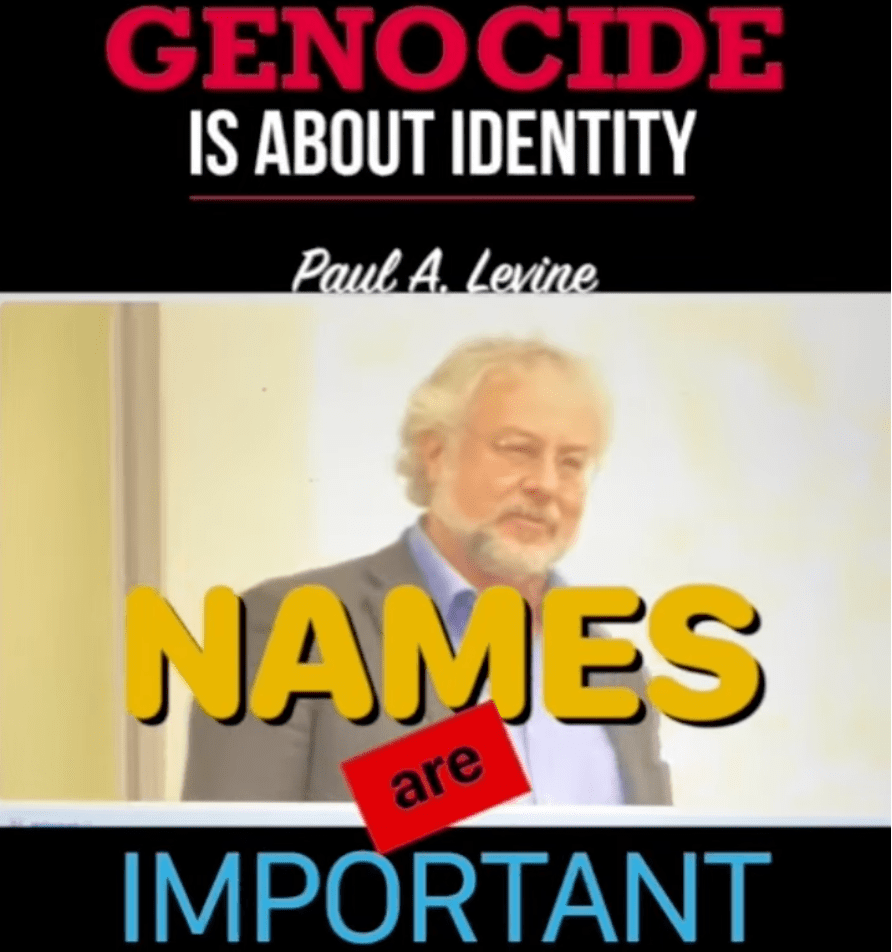
Be Part of a Living Memorial: Our channel is a digital monument honoring Levine’s memory—an initiative led by students to keep his teachings alive building a meaningful virtual tribute.
– In Arabic, Turkish & Persian about the Holocaust –
The only book of its king In Arabic, Turkish & Persian. «Tell Ye Your Children; A Book about the Holocaust, 1933- 1945» written by Paul A. Levine and Stephane Bruchfeld.
The book “Tell Ye Your Children…”, written for children, is telling stories about children and is addressed primarily to adults.
– Looking back at “Protecting the Future” in Moscow, 2018 –
Despite Levine’s courage in expressing a strong civil democratic position and fulfilling of historian’s responsibility in the lair of the autocrat, his act and its signal message remains quite unknown.






 You can read our latest appeal (2) to the university, but here’s the heart of it:
 How stable is the memory we rely on, and how easily can it collapse?








 Paul A. Levine Library